
For the L-Word of the Game
Or: happy day of love, happy Black History Month, somehow both these things are connected

Launch—to begin
Happy February!
It’s colder, currently snowing, and I haven’t left my house in weeks. There’s something about frigid solitude that leaves you contemplating love.
Truthfully, I’m always contemplating love.
It’s human nature, I think, to consider love in everything you do, everything you experience, everything you are.
Love is one of those concepts that poets, screenwriters, authors, painters, sculptors, cartoonists, directors, singers, composers, and more have spent centuries trying to conceptualize, explain and wrap up in neat packages for consumption but have never been able to truly crack what love means.
It’s expected—we can explain how we breathe, why we need to breathe, and what a lack of breathing means in the grand scheme of things, but we can never truly understand why it’s deeply ingrained in every living thing to breathe.
It’s one of those mysteries filled with so many explanations—scientific, theological, spiritual—that leaves you picking the one you prefer the most and basing your entire existence around that.
The concept of love has never been the same across the board, but isn’t that what makes love such a beautiful thing?
It can be sweet, obsessive, compassionate, controlling, tender, possessive, nurturing, destructive, soft, toxic, patient, abusive, respectful, manipulative, playful, reckless. And this is across all boards: romantic, familial, platonic.
Not to expose myself on main, but I think every version deserves a place in media. In the name of variety!!
Loathe—to hate
With the rumination on love, the acknowledgement of love being necessary in media, and the joy that exists in variety, I have to admit I constantly have an internal fight when writing romance.
I absolutely hate writing romance in most cases, even though none of my stories will ever not have a romance. Even though I am as much of a romance author as I am a SFF one.
Why can’t the romance just be the family we found along the way?
It’s also Black History Month, and I am nothing if not a multi-tasker: there’s an additional responsibility I bear every time I sit to write a love story that features a Black person. Especially if there’s a Black girl involved.
Because love as a concept is so inconceivable, because it’s everywhere around us, because it influences every single thing—and is, in turn, influenced by every single thing—it’s also easily twisted.
Everything is both deeper and not deep at all. And when we bring in misogynoir… it’s all a direct reflection of how the writer and the reader approach romantic love in the concept of the desirability of a Black woman.
Something this month absolutely pissed me off!
I gave myself time to sit with the hurt, to think on the hurt, to bring love into the hurt. Unfortunately, I am a hater, first and foremost. And since love is such a broad thing that can really be anything at all… isn’t hating just another form of love?
Long—to desire
I spoke previously, and very briefly, on never feeling loved back by the stories I grew up loving. About how that desire to see myself in canon led me down the path of creation to begin with.
Superhero media will always be my north star. It’s where I first felt at home, where I’ll always gravitate towards, and where I long to see myself the most. Of course, there are several Black female superheroes—Storm, Vixen, Bumblebee, to name a few—but there’s a problem here we can’t ignore.
One: how many projects focus solely on those characters? Of course, there was the animated Vixen show in 2015, but it was cancelled as soon as it started. Take a guess why.
And, two: saving the world is not my ministry; get somebody else to do it. Where’s my Black Lois Lane? My Black Mary-Jane? You can keep that hero’s journey, love interest me please.
Candice Patton from Flash (2014) and Anna Diop from Titans (2018), thank you both for your service. (I will never resign Starfire to a simple love interest, but I was vindicated after years of telling people she was based on a Black woman because of the comics!)
But that wasn’t enough. After years of not seeing myself in the love interest role, I needed more.
What is it about repression that welcomes insatiability?
After years of desiring, it finally happened!
Invincible (2021) was everything I wanted and more! A teenaged superhero having to deal with regular teenaged stuff while superheroing, a Black love interest, an animated show, and his last name is GRAYSON (For all my DC fans, iykyk).
It was meant for me and me alone.
But I’ve seen this show before. It just took me a minute to realize where.
To understand the future, we have to look at the past.
Danny Phantom (2004) was everything I wanted and more. A teenaged superhero having to deal with regular teenaged stuff while superheroing, a Black love interest, an animated show, and his last name was Fenton (no connection there, but go with it.)
Learn—to understand
The Disposable Black Girlfriend Trope, or as I like to call it: the bane of my existence and everyone involved will be going to hell, means a Black woman is resigned to the first girlfriend syndrome.
She’s the obstacle for the main couple to overcome. A speed-bump, if you will.
Most of the time they have more chemistry with the hero.
Most of the time, they’re race-swapped (more on this soon).
Most of the time, during their relationship with the hero, everyone becomes a hardcore feminist.
Now it’s all “why are you guys so ship-obsessed,” and “why can’t they just be friends?” and “they’re so sibling-coded!” and “we need more healthy platonic friendships between men and women,” and “a girl shouldn’t be defined by romance, she doesn’t need a man!” and “she’s too much of a queen, I can’t imagine her with anyone,” and “she’s kind of manipulative, she doesn’t deserve him,” and more and more and more and more.
When it’s race-swapped, however, I think that’s the most egregious part. If we go back to Invincible (2021)—the thing that pissed me off this month—Amber was originally a white, blonde girl in the comics.
She was changed to a Black character in the animated series and the creators spent an awful amount of time making her controversial in the fandom, welcoming vitriol from comic fans who already loved another character (who already knew who he would end up with) as well as doing nothing to dissuade against the utter racism that was on my timeline.
There were famous tweets back when season 1 debuted calling her the ‘true villain’, as opposed to the actual villain.
The actual villain who was, and I cannot stress this enough, an alien colonizer sent to Earth to enslave it, who had a child with a human—who he then called a ‘pet’—who spent the entire finale brutalizing his ‘invincible’ son, while also telling said son he could spend another seventeen years, starting over, and having another child who’d be willing to colonize the planet with him.
There’s a reason why this trope exists, there’s a reason why it’s been done so many times now that it’s considered a trope, but to truly understand why we can’t make headway on this, I’m gonna insert a Reddit topic here about the same discussion.
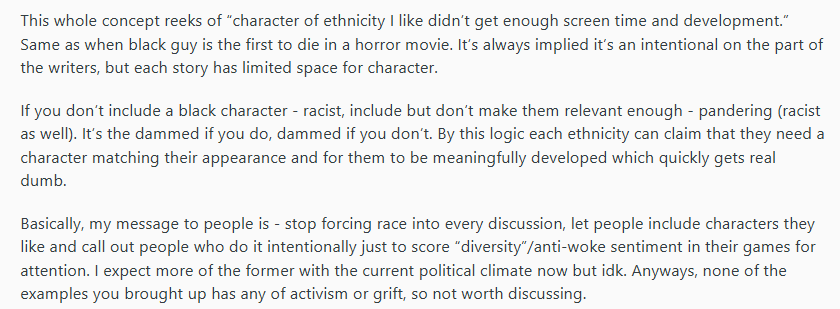
You see the shit I have to deal with?
The Disposable Black Girlfriend trope, at its core, comes from writers not having a genuine interest in exploring Black women, Black girls, as actual characters. There’s no agency, no complexity, no effect on the narrative whether you take them out or not.
If we go back to Launch and Loathe, respectively: there is nothing wrong with frigid solitude, nothing wrong with not being “chosen,” but there absolutely is something wrong when a lack of desire—on the part of both the creator and consumer—leads to these characters being no more important than a lampshade.
Lobby—to pressure
Don’t get me wrong, I’m not begging anyone to take up a pen to please me. There are no strings on you and no pressure from me at all!
By all means, tell your story how you believe it needs to be told but be true to the story you want to tell.
There’s this idea that being starved of representation means minorities will accept anything.
And maybe that’s true—I would never dare to speak for everyone. But in my house? On Beyoncé’s internet? Don’t attempt to play in my face.
I’ve been repressed. I’ve been insatiable. I’ve been satisfied, at times. But above all else, I have self-respect. And with that comes my anger.
I’ve always admired how scent can unlock memories. How you’ll forget something completely, and have this olfactory reaction that takes you back to when you were four and playing on a fraying couch.
You can’t even remember what you looked like at four, you can’t recall the colour of the couch, but your subconscious knows the feel, smell, taste—if you were a weird child—of it all, and it will bring you there every time you come across that one specific smell.
When I smell bullshit in the air, I’m immediately taken back to Danny Fenton and Valerie Gray’s relationship.
If you don’t know the GrayGhost lore, pull up a chair!
GrayGhost, obviously, is the pairing of Valerie and Danny. Valerie is a ghost-hunter named Red Huntress, Danny is a ghost—he’s a Phantom.
Danny’s a good ghost, so Danny Phantom and Red Huntress had a rivalry going on. In the midst of this rivalry, they were close friends in their civvies, and on top of that, they had a bit of identity porn going on cause Valerie had a crush on Danny without knowing he was Phantom, and Danny had a bit of a crush on Valerie while knowing she was both.
All caught up? Good.
I was two—technically one since the first episode aired April 3, 2004, exactly one month before my birthday—when the show first aired. I watched it all at seven years old.
I’ve always thought, therefore I always was; at seven years old I knew how to clock a clock when it was clocking.
At seven, I had no idea what the deal was but I knew something nefarious was afoot. A decade later, especially after finding out the truth, I realized the joke has always been on me.
Seasons 1 and 2 built this relationship between Danny and Valerie. There was such an immediacy in their interactions that felt deliberate. There was a natural progression, then season 3 happened and everything blew up. Granted, it is generally accepted that season 3 had terrible writing, but the tone and direction changed as well.
Danny and Valerie were meant to be endgame. What happened then was there were creative differences between Nickelodeon and one of the writers. A plus size Black girl being with one of the biggest cartoon star at the time? Absolutely not.
The writer, Steven Marmel (who was the mastermind behind concepts such as Dark Danny, GrayGhost, etc etc) left as his vision was not going to happen on the network. The writer who remained chucked all his efforts out the window, chose not to explain what happened, and then shoehorned this relationship between Danny and Sam in a way to erase GrayGhost, and ensure everyone knew this was to be the case from the start, even though there was no build up.
According to the Redditer from Learn: people believe they’re damned if they do, damned if they don’t. They don’t think race should be a factor when discussing this type of erasure. Each story has a limited space for each character.
Why isn’t it worth discussing when the erasure, the limited space, and the feeling of being damned regardless all ties back to Black girls in media?
Love—to do
Like I said before, a lot of the times I truly hate writing romance.
I know the battles I’ll have to cross, I know the society I live in, I know the way love is seen when Black girls are at the forefront.
However.
If not me, who?
Readers will say I’m promoting something toxic or unattainable or say they can’t relate. And, because I tend to write a lot of homoerotic relationships, they’ll push another ship with the character to erase these Black girls from their own narratives.
But… I don’t have to sweeten my delivery to make it work for Todd. Who the fuck is Todd?
My meaning of love has always been rooted in a verb; if nothing else, love is to do. My version of love, even if it’s hate-first, will be done.
As long as I am literate and able, I will write these love stories that are sweet, obsessive, compassionate, controlling, tender, possessive, nurturing, destructive, soft, toxic, patient, abusive, respectful, manipulative, playful, and reckless. These stories will have Black girls at the centre.
For every seventeen-year-old Black girl finding out the media they grew up with saw them as nothing more than disposable, there will be a seven-year-old Black girl who doesn’t have to clock in to recognize that she’s worthy of being loved.
Thanks for reading!
-Ash
yknow i literally always did hate danny ending up with sam as a kid, but i havent rewatched the show since ive gotten older to understand why and you just told me why straight to my face. it hurts that thats how we were always shown to perceive ourselves in 90% of the media we watched growing up and have had to claw tooth and nail to get out of it. incredible work Ash I loved this ❤️